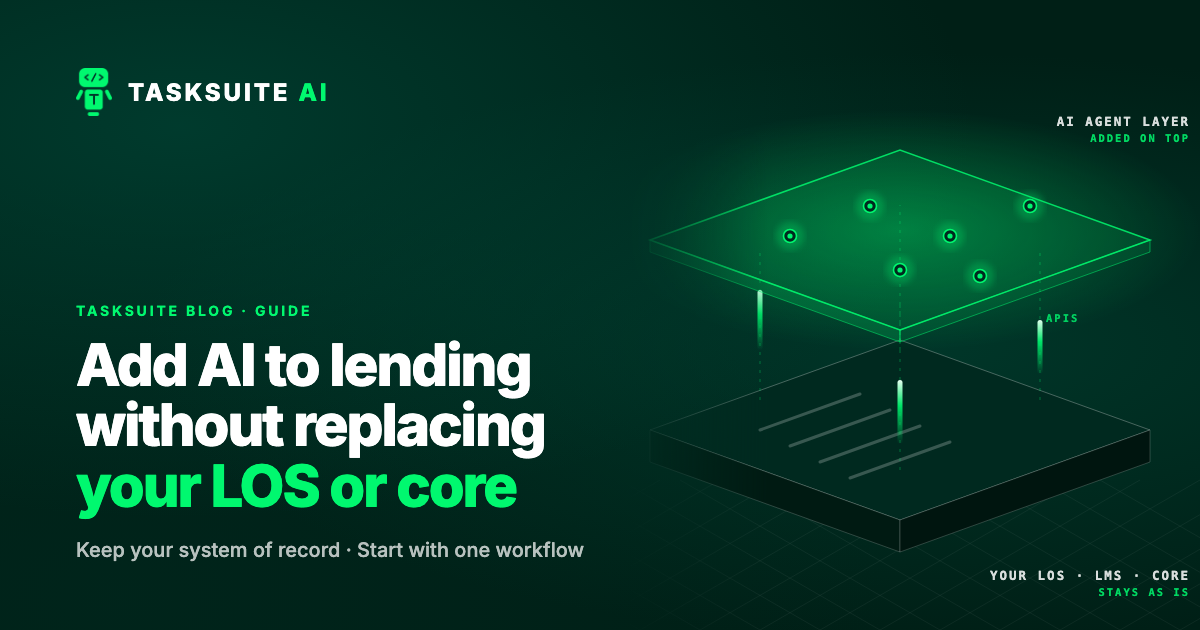
Most lenders that want AI in 2026 already own a loan origination system (LOS) that records loans well. What it leaves to staff is the work around the loan: collecting documents, checking that a file is complete, chasing borrowers, re-keying data between systems and assembling the credit memo. That work doesn't need a new system of record. It needs something that does the work and writes the results back to the system you have.
This guide covers the three ways to add AI, how the connection to your LOS and core actually works, what to automate first, and what regulators expect.
Do you need to replace your LOS to use AI?
Usually not. Replace your LOS when it can't support a product you need, your vendor is ending support, or keeping it clearly costs more than migrating. If none of those is true, a replacement is a slow and risky way to get AI: a multi-month project that consumes the same lending staff who are already short on time.
The simpler model is to keep two jobs separate:
| Your LOS, LMS and core keep | An AI agent layer handles |
|---|---|
| The official loan, account and payment record | Requesting, classifying and checking documents |
| Credit decisions and approval authority | Flagging missing or inconsistent items and following up |
| Booking, funding and servicing ledgers | Re-keying and cross-checking data between systems |
| Your configured products and rules | Drafting credit memos and QC checklists for review |
| Regulatory record retention | Logging every action it takes |
What are the three ways to add AI to lending?
| Path | What it means | Best when | Watch out for |
|---|---|---|---|
| Turn on your LOS vendor's AI | Use agents your incumbent builds into its own platform | Your bottleneck sits inside that one platform | Coverage stops at that vendor's platform |
| Add an agent layer on your existing systems | Agents connect to your LOS, LMS, core and document stores and work across them | The manual work crosses several systems | Ask exactly which records and fields the vendor reads and writes |
| Replace the LOS with an AI-native one | Migrate to a new LOS with AI built in | Your LOS can't support your products or is being retired | Migration time, data conversion and retraining |
The first two aren't mutually exclusive. Many institutions use their vendor's AI for work inside the LOS and add an agent layer for work that spans systems.
The incumbents are moving quickly. In November 2025 nCino launched five role-based "Digital Partners" (Executive, Analyst, Service, Processor and Client). In March 2026 Blend launched Autopilot, which Blend describes as a non-decisioning agent that reviews borrower documents against lender guidelines and generates follow-ups. In May 2026 Blend opened its platform to lender-built agents through Autopilot MCP, a Model Context Protocol server. If you run those platforms, those are real options. They also point the same way: AI is arriving as a layer on top of the system of record, not as a reason to replace it.
How does an AI agent connect to your LOS and core?
An agent is only useful if it can see the loan file and put its work back where your team works. In practice the connection has four parts:
- Read access. The agent reads only the application, borrower and document records the workflow needs.
- Document intake. Uploads, emails and portal submissions flow to the agent, which classifies each document and matches it to the right loan.
- Write-back. Results go back into the system of record: document status, extracted data, open conditions, a draft credit memo.
- Status updates. When something changes (file complete, document missing, memo ready), the agent updates the record or triggers the next step, so nobody has to check a second screen.
The usual pattern is a REST API with a dedicated, permission-scoped service account, plus webhooks for status changes. Before you sign, confirm with your LOS vendor which API access your contract includes. That is often the real constraint, not the AI.
Which workflow should you automate first?
Pick one that is high-volume, easy to measure and low-risk because a person still makes every credit decision. For most lenders, that is document collection.
| Workflow | Why it's a good start | What to measure |
|---|---|---|
| Document collection and completeness checks | Every loan needs it, and incomplete files are the most common cause of delay | Days from application to complete file; staff touches per file |
| Data cross-checks | Matching the application against pay stubs, bank statements and tax returns is tedious and error-prone | Exceptions caught; review time |
| Credit memo preparation | Underwriters spend hours assembling memos before they make a judgment | Time from complete file to memo ready |
| Loan file QC | Pre-funding and post-close QC follow checklists an agent can apply consistently | Files reviewed per week; defects found |
Starting with documents also helps everything after it: underwriting, closing and servicing all run better on a complete, validated file.
Do banks, credit unions and specialty lenders need different things?
The workflows are similar. The pressure points differ.
| Banks and credit unions | Specialty and alternative lenders | |
|---|---|---|
| Main constraint | Exam readiness and fitting into an established core | Products and fees standard systems don't model well |
| What matters most | Audit trail, consistent policy, clear human sign-off | Handling factor rates, holdbacks and variable remittances |
| Document challenge | High volume of standard documents | Messy, mixed formats: bank and merchant statements, contracts |
| Integration context | LOS and LMS plus a core, often with limited IT time | Commercial and in-house systems, with spreadsheets in the gaps |
How do you add AI without a migration?
- Name the bottleneck. Find the one process where files stall, and measure it today so you can compare later.
- Map the systems it touches. List your LOS, LMS, core, document storage and borrower portal, and confirm which have APIs.
- Write the guardrails first. Decide what agents may do alone (request a missing pay stub), what needs a person (clear a condition, approve, decline), and what must always be logged.
- Connect read-only first. Let agents produce their output to a review queue before you allow any write-back.
- Run in parallel on real files. Compare the agent's work with your team's before it touches production records.
- Turn on write-back with a scoped account. Grant only the records and fields the workflow needs.
- Expand one workflow at a time on the same connection.
What do regulators expect?
- Credit unions. The NCUA says credit unions may use AI, that it has not issued AI-specific rules, and that existing regulations are technology-neutral and apply to AI. Examiners look at safety and soundness, compliance, internal controls, ongoing risk monitoring and third-party due diligence.
- Banks. The 2023 Interagency Guidance on Third-Party Relationships applies to AI vendors. On September 11, 2026 the FDIC, OCC, Federal Reserve and NCUA proposed new guidance that would replace it once finalized, with oversight tailored to each relationship's actual risk.
- Fair lending. If AI contributes to a credit decision, applicants are still owed specific, accurate reasons for an adverse action under the Equal Credit Opportunity Act and Regulation B. Logging the reasons behind every recommendation makes that easier to show.
An agent layer that keeps people on decisions, logs every action and touches only the data it needs is far easier to explain in an exam than a black box.
Where does TaskSuite fit?
TaskSuite's AI agents deploy on the LOS and LMS you already run, with no migration, and read from and write back to the same records as your team. TaskSuite also offers its own full LOS and LMS, the Loan Suite, for lenders that want one platform.
- Credit agents: credit memo, document intelligence, bureau data, fraud detection, decisioning and risk analytics. See the Loan Credit Agents.
- Origination agents: lead outreach, qualification, application assistance, document collection, contracts and e-signature, and pipeline analytics. See the Loan Origination Agents.
- Servicing agents (payments, escrow and insurance, collections, borrower communications) are coming soon.
- Control stays with you. Decisions follow your own credit policy, every recommendation is explainable and logged, and you choose which steps need a person's sign-off.
- Prebuilt, custom or built for you. Use prebuilt agents, build your own, or have TaskSuite build them for you.
Questions to ask any AI vendor before you sign
- Which of our systems will you read from and write to, and which records and fields exactly?
- How do you connect, and what do we need to license or provision on our side?
- What can an agent do without a person, and how do we configure that?
- Show us the audit trail for one agent action, from the document it read to the record it wrote.
- What happens when a write to our LOS or core fails, and where does it show up?
- Can you test against a non-production copy of our systems first?
- Will you run one real workflow on our sample files before we commit?
Key takeaway
You don't need a new LOS to use AI. Keep your LOS, LMS and core as the system of record, add agents for the work around the loan, start with document collection, and keep people on every credit decision with an audit trail behind it.
Related: Which AI solutions fit banks and credit unions, by use case and AI underwriting, explained.
Vendor features and regulatory guidance change. Confirm current details with each vendor and your examiner.