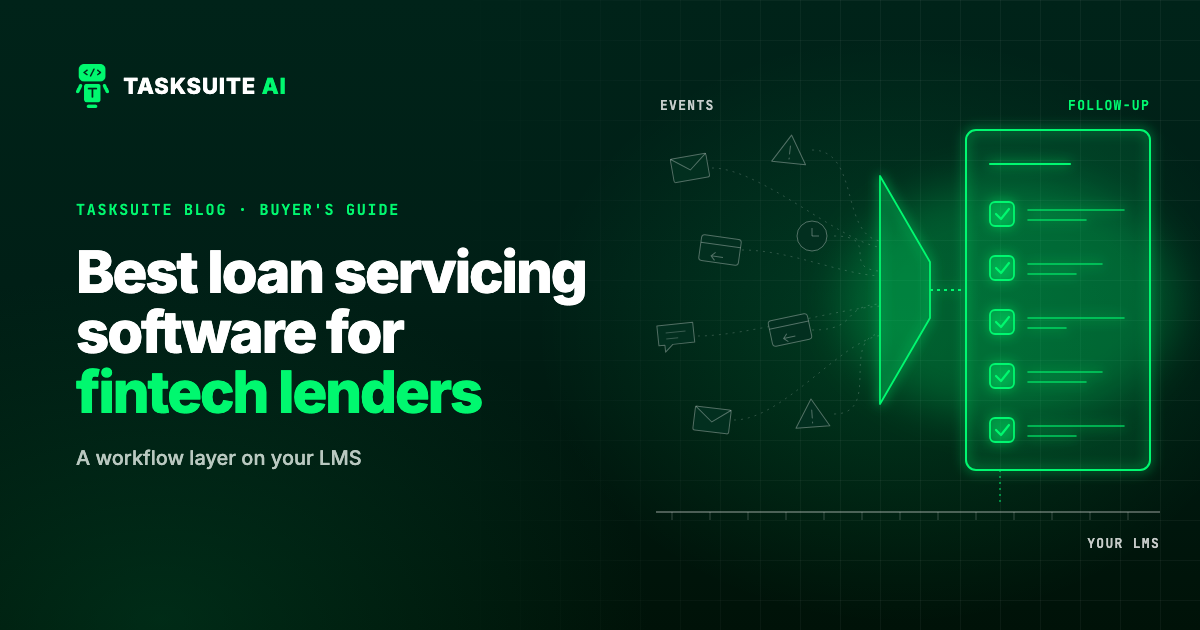
The best loan servicing software for a fintech lender is the one that fixes where your servicing work stalls, and for most non-bank lenders that is collections and borrower follow-up. TaskSuite AI runs lending workflows with agents on the loan management system (LMS) you already use, and its team builds those workflows with you. A built consumer workflow triages a returned payment. The Servicing Suite can hold the ledger if you want one: it tracks payments and collections and gives borrowers a portal. LoanPro, Peach, Canopy, Nortridge and Mambu are systems of record that hold the servicing ledger, each with its own focus. Lokta pairs its own LMS with an AI servicing agent. Pick a ledger for how you book loans. Then decide who, or what, does the daily follow-up work.
Why do collections and borrower follow-up slow fintech servicing teams down?
Picture a typical Monday. An ACH payment came back NSF over the weekend. A borrower wants a payoff quote. Several accounts crossed into early delinquency. Each needs a person to notice it, look up the loan, send the right message and log what happened.
Most loan servicing software records those events well. The ledger knows the payment returned. The work around the event, such as the reminder, the cure notice, the promise to pay and the escalation, often still runs through queues, inboxes and spreadsheets.
That is why fintech lenders compare servicing software on two questions, not one:
- Is the ledger right for our products? That covers payment allocation, fees, schedules, retroactive changes, credit reporting and compliance rules.
- Who does the follow-up? People working queues, rules the vendor configures, or AI agents that prepare the work for your team to approve.
The vendors below answer those two questions differently.
What does TaskSuite handle in loan servicing?
TaskSuite AI runs lending workflows with agents on the LMS you already have. They connect through APIs, with no migration (TaskSuite FAQs). On the consumer loans Pack, which runs today, a returned payment is triaged (TaskSuite Packs). If you want TaskSuite's ledger as well, the Servicing Suite tracks payments, balances and default status, automates payment processing and late-fee calculation, and gives borrowers a white-labeled portal. It includes compliance monitoring. The same suite covers portfolio management, the borrower portal and collections (TaskSuite FAQs).
TaskSuite uses role-based access control, and every run lands on an audit log. Agents prepare the work. A person signs before a change is written, and declines are never automatic (TaskSuite Engine, TaskSuite FAQs). TaskSuite supports small-business loans and merchant cash advances, personal, student and auto loans, and buy-now pay-later products, configured to your products and workflows (TaskSuite FAQs).
What do LoanPro and Peach cover after a loan is booked?
LoanPro calls itself an API-first lending and credit platform and says 600+ lenders use it (LoanPro). Its Servicing Suite includes a rule-based automation engine, a communications suite, a borrower portal and role-based access for staff and AI tools (LoanPro Servicing Suite). Its Collections Suite adds prioritized collections queues and self-service hardship enrollment (LoanPro Collections Suite). LoanPro's MCP connects any AI model, checks agentic actions against your policies, and keeps an audit trail (LoanPro AI in lending).
Peach, now part of SoFi Tech Credit Solutions, is an API-first loan management and servicing platform (Peach). It starts at loan booking and does not handle origination, underwriting or KYC (Peach llms.txt). Its Servicing Suite covers borrower portals, agent tools, payment processing and collections (Peach platform). Its Compliance Guard tracks rules such as FDCPA, SCRA, TCPA and Reg F and checks each outbound interaction before it sends (Peach). It reports Metro 2 data to TransUnion, Experian and Equifax (Peach for fintechs). Its servicing CRM can summarize case notes with AI (Peach case notes).
What do Canopy and Lokta offer a non-bank lender?
Canopy is a loan management and servicing system built for B2B lending programs (Canopy). It supports working capital, lines of credit, merchant cash advances, installment loans and BNPL, with collateral tracked against the loan tape (Canopy use cases). Its automations cover tasks from FAQs to payment reminders, alongside a self-service borrower portal (Canopy customer support).
Lokta describes itself as an agentic loan servicing platform that puts the LMS, loan accounting, servicing and collections in one governed platform (Lokta). Its servicing agent handles borrower queries, collections prioritization and recovery follow-up, and a named person approves the financial actions a workflow marks for review. It is built for NBFCs and fintech lenders in India and for non-bank lenders in any market (Lokta AI loan servicing).
What do Nortridge and Mambu publish about servicing?
Nortridge Loan System is configurable loan servicing software that processes ACH, card and check payments under configurable rules (Nortridge). Its collections tools include a collector workspace, collection campaigns, promise-to-pay tracking and more than 150 standard reports (Nortridge loan collections). It publishes pricing, with an optional escrow analysis module, from $1,200 a month plus $1,750 setup (Nortridge pricing).
Mambu is a composable, cloud-native core banking platform, with deposits beside lending (Mambu cloud banking). Its lending menu lists consumer loans, business loans, BNPL and retail mortgages (Mambu lending). Mambu Agentic is an intelligence layer with human oversight, guardrails and an audit trail (Mambu Agentic). It fits a lender that wants a banking core, not only a servicing ledger.
How do the main loan servicing platforms compare?
Read the table as two choices. The first is whether the vendor holds the servicing ledger. The second is who does the follow-up once a payment fails or an account goes late. TaskSuite's Servicing Suite can be that ledger. Its agents also run on the LMS you already have, and a person signs before a write. Lokta puts the agent and the ledger in one platform and requires a named approver for flagged financial actions. LoanPro and Peach are ledgers with collections tools and a stated control on AI. Canopy and Nortridge publish the collections workflow and, in Nortridge's case, the price. They do not describe an AI servicing agent on the pages reviewed. Mambu is the core-banking option when the book sits next to deposits.
| What it is | Collections and borrower follow-up | AI in servicing | Published pricing | |
|---|---|---|---|---|
| TaskSuite AI | Agents on your LMS, plus the Servicing Suite if you want the ledger | Returned-payment triage; Servicing Suite covers payments, the borrower portal and collections | Agents prepare the work; a person signs before a write | Custom quote by team size, Suites or workflows, and loan volume |
| LoanPro | API-first lending and credit platform | Collections queues, hardship programs, automation engine | MCP to connect your own AI models, with policy checks | Not published |
| Peach | API-first servicing platform from booking onward | Collections tools, case management, Compliance Guard | AI-powered case notes summarization | Not published |
| Canopy | LMS and servicing for B2B lending programs | Automated payment reminders and custom workflows | Not stated on the pages reviewed | Not published |
| Lokta | Agentic servicing platform with its own LMS | Overdue follow-up, promises to pay, recovery tracking | Servicing agent proposes; policy and approvers decide | No platform fee for 24 months up to about $10 million in assets, then $100 per $1 million a month |
| Nortridge | Configurable loan servicing system | Collector workspace, campaigns, promise-to-pay tracking | Not stated on the pages reviewed | From $1,200 a month, plus $1,750 setup |
| Mambu | Composable cloud banking core | Not detailed on the pages reviewed | Mambu Agentic, with human oversight | Not published |
Where do AI agents fit in underwriting, servicing and collections?
AI agents in lending prepare the routine work so your people spend time on the decision. In underwriting, TaskSuite's agents read the file and cite the page each fact comes from. Rules hold your credit policy. The Credit Suite handles bureau scoring, fraud checks and underwriting, and a person signs at the HITL Gate (TaskSuite Engine, TaskSuite FAQs).
On the servicing side, the same rule applies. The consumer loans Pack triages a returned payment (TaskSuite Packs). The Servicing Suite tracks payments and default status, calculates late fees and gives borrowers a portal (TaskSuite Servicing Suite). Agents do not write to your systems. One integration makes each signed write, and the audit log records it (TaskSuite FAQs).
Lokta and LoanPro take a similar stance on control. Lokta's agent proposes and its core checks the policy before anything posts (Lokta AI loan servicing). LoanPro's MCP checks agentic actions against your policies (LoanPro AI in lending).
The rule worth keeping is simple. Agents prepare and recommend. Your servicing and collections team decides.
How does TaskSuite run servicing on your existing LMS?
TaskSuite starts from a Pack, not a blank page. Going live is three moves (TaskSuite Oversight):
- Set up. Your products, credit policy and Rules are loaded once.
- Connect. Agents point at your LOS or LMS, or run on TaskSuite Lending. There is no rip-and-replace.
- Operate. Agents do the checking, your people sign, and every step lands on the audit log.
The agents read the same loan data as your team. A change is written only after someone signs (TaskSuite FAQs). They can run beside the LMS you use today, or on TaskSuite Lending if you want origination, credit, servicing and loan management on one platform (TaskSuite Lending).
The workflow is tailored to how you lend. Tell TaskSuite's team the workflow, and it builds that Pack or workflow with you. You tailor it with your own Rules, without writing code (TaskSuite FAQs). That experience comes from the loan desk: the team spent years running origination and servicing operations before building the software (About TaskSuite).
How do you choose loan servicing software for a fintech lender?
Start with your products and your bottleneck, then test on your own loans.
- Map your products. List installment, line of credit, MCA, BNPL, cards and anything else you service. Confirm each vendor supports them.
- Decide on the ledger. If your LMS already books loans correctly, you may need the follow-up work done, not a new ledger.
- Trace one delinquent loan. Ask each vendor who sends the reminder, records the promise to pay, escalates and records the cure.
- Check compliance in the workflow. Ask how the system handles contact limits, servicemember protections, credit reporting and an audit trail of who did what.
- Ask about AI controls. Find out what an agent can do on its own, what needs approval and where every action is logged.
- Price the same scope. Compare quotes on the same products, loan volume and users. Include setup and migration fees.
A short pilot on a slice of your book will tell you more than a feature list.
What else do fintech lenders ask about loan servicing software?
What is loan servicing software?
Loan servicing software manages a loan after it funds. It covers payment posting, escrow, statements, borrower communications, delinquency and collections, payoffs and modifications, and portfolio and regulatory reporting.
Do I need to replace my LMS to add AI to servicing?
No. TaskSuite AI runs on the LOS or LMS you already have and connects through APIs, with no migration (TaskSuite FAQs). LoanPro takes a different route, letting you connect your own AI models to its core through its MCP (LoanPro AI in lending).
Can AI agents handle collections without my team?
They should not. On TaskSuite, a person signs before a change is written, and declines are never automatic (TaskSuite FAQs). Lokta requires a named person to approve the financial actions a workflow marks for review (Lokta AI loan servicing).
How is loan servicing software priced, and which loans can it cover?
Nortridge starts at $1,200 a month plus $1,750 setup (Nortridge pricing). Lokta charges no platform fee for 24 months up to about $10 million in assets, then $100 per $1 million of assets a month (Lokta pricing). LoanPro, Peach, Canopy and Mambu do not publish a price on the pages reviewed. TaskSuite quotes from your team's size, the Suites or workflows you need, and your loan volume (TaskSuite FAQs).
Which loan types does TaskSuite service?
TaskSuite supports small-business loans and merchant cash advances, personal, student and auto loans, and buy-now pay-later products, configured to your products and workflows (TaskSuite FAQs). For the wider system choice, see the best loan management software, an end-to-end lending platform from origination to servicing and how to add AI to lending without replacing your LOS. To see a workflow on loans like yours, book a demo.
Sources
- LoanPro, "Loan Management Software" (2026)
- LoanPro, "Loan Servicing Software" (2026)
- LoanPro, "Collections Suite" (2026)
- LoanPro, "AI in lending" (2026)
- Peach, "API-first loan management and servicing software" (2026)
- Peach, "Loan Management Platform Built for Engineers" (2026)
- Peach, "Fintechs" (2026)
- Peach, "llms.txt" (2026)
- Peach, "AI-powered Case Notes Summarization" (2023)
- Canopy, "Loan management system" (2026)
- Canopy, "The platform for B2B and commercial lending" (2026)
- Canopy, "Improve borrower experiences" (2026)
- Lokta, "The agentic loan servicing platform" (2026)
- Lokta, "AI loan servicing software" (2026)
- Lokta, "Pricing" (2026)
- Nortridge, "Loan Servicing and Management Software" (2026)
- Nortridge, "Loan Collections Management" (2026)
- Nortridge, "Pricing" (2026)
- Mambu, "Cloud Banking Platform" (2026)
- Mambu, "Lending" (2026)
- Mambu, "Mambu Agentic" (2026)
- TaskSuite, "FAQs" (2026)
- TaskSuite, "Packs" (2026)
- TaskSuite, "Servicing Suite" (2026)
- TaskSuite, "Engine" (2026)
- TaskSuite, "Oversight" (2026)
- TaskSuite, "TaskSuite Lending" (2026)
- TaskSuite, "About TaskSuite" (2026)