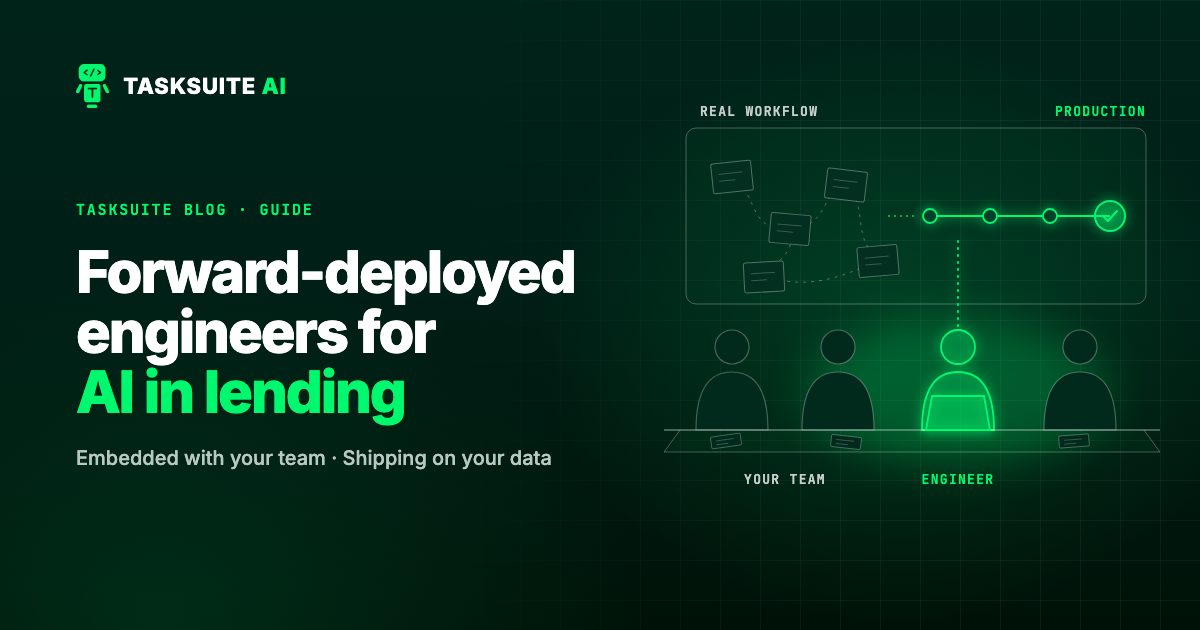
A forward-deployed engineer (FDE) is a software engineer who works inside a customer's operation and builds on its real data and systems. The aim is a working result in production, not a demo. In lending this model works because what blocks AI is rarely the model. It is the deployment: the documents, the lender's own credit policy, the systems the loans live in, and the controls a regulator will ask to see.
What is a forward-deployed engineer?
Palantir made the role famous. Its job posts call it "the blueprint" and say: "We pioneered this unique position, embedding talented engineers directly with our customers to tackle their most pressing challenges head-on." Its 2020 S-1 described the payoff for the product: "As FDEs help customers make the most of our software, they observe users' challenges firsthand."
The model has spread fast, well beyond Palantir. An analysis of 1,000 job posts found that jobs titled forward deployed engineer grew 1,165% year over year in 2025 (Bloomberry).
The idea is simple. An FDE sits with the people who do the work, maps how it really happens, builds against the customer's own data, and feeds what they learn back into the product. The customer gets a result that fits. The vendor gets a product shaped by real work instead of guesses.
Why do most AI projects in lending stall before production?
The gap between trying AI and getting value from it is wide. BCG found that 60% of companies have "little or no value to show" for their AI investment, and only 5% qualify as "future-built". In financial services, Deloitte found that 24% of firms have moved 40% or more of their AI experiments into production.
Adoption is not the problem. Cornerstone Advisors reports that 49% of banks and 59% of credit unions have deployed generative AI.
Deployment is. Colin Jarvis of OpenAI said that "in about 80% of cases" the problem is deployment, not the model (TNW). MIT's NANDA study found that buying from specialized vendors and partnering "succeed about 67% of the time, while internal builds succeed only one-third as often." That finding is "particularly relevant in financial services" (Fortune).
Why does lending need engineers inside the process?
Lending is hard to automate from the outside, for four reasons.
- Documents are messy. Tax returns, K-1s, bank statements and personal financial statements arrive scanned, bundled and in a dozen formats.
- Every lender's credit policy is different. The same file can pass one lender's checklist and fail another's. The rules have to be the lender's, not the vendor's.
- Loans live in existing systems. The AI has to read from and work alongside the LOS or LMS you already run.
- The controls must be checkable. On November 4, 2026 the OCC issued its first examiner framework for generative and agentic AI. It expects that documentation "should allow a third party to reconstruct a material AI decision," and says "accountability stays with the bank even when a vendor builds or hosts the tool" (King & Spalding).
The OCC's revised model risk guidance, which replaced SR 11-7 in April 2026, says generative and agentic AI models "are not within the scope of this guidance" (OCC Bulletin 2026-13). Lenders still have to show how they control them. An engineer who knows the process can build that control in from the start.
What does it look like when it works?
The clearest public example in lending is Customers Bank. It works with OpenAI, whose engineers "sit beside the team to build custom tools for the bank's processes." They work with the bankers who own each task, "build agents on the bank's own data and systems, then measure the result before the agent joins daily operations." In a pilot, select commercial loans closed in seven days, against the bank's typical 30 to 60 (PYMNTS).
Palantir describes the same pattern at scale. Its 2025 annual report says its AIP bootcamps "deliver real workflows on actual customer data in days," and that "we embed directly with customers across numerous industries" (Palantir 10-K).
The common thread is not the vendor. It is the method:
- Start with one real workflow.
- Build on the customer's own data.
- Agree how success is measured before anything goes live.
What are the risks of forward-deployed engineering?
The model has real failure modes, and critics name them clearly.
- Bespoke code nobody can maintain. Marty Cagan of SVPG says there is likely "no faster path" to value than embedding with customers. He warns that a company with only FDEs would end up with "thousands of large, bespoke solutions that would need to be maintained and improved indefinitely" (SVPG).
- Services economics. Engineers on site cost money. a16z argues "it's shortsighted to be optimizing for 80% gross margin" early, because "human-intensive services are necessary" to build great software, but the services have to turn into product (a16z).
- Dependence on the vendor. OpenAI's Jarvis is blunt about the goal: "we should always be temporary" (TNW). Palantir's S-1 describes customers who "become more self-sufficient" over time.
The fix is the same in each case. Time-box the work. Build on a shared platform instead of forks. Measure results. Make sure every engagement leaves the product better for the next customer.
How does TaskSuite work with a lender?
TaskSuite builds this way. As our FAQ says, we set up your products, credit policy and Rules once, connect the Agents to your LOS or LMS, then run read-only first, with your people at every HITL Gate. Our team spent years running origination and servicing operations before building the software.
The work starts with one real loan file. We follow it through your process and write down what your people check, who signs off and where the documents come from. That becomes the Record, with a lending ontology of your loans, parties, documents and decisions, and your Rules.
What we build goes into Packs, not one-off code. A Pack is a product's workflows, agents and rules, built with you and tailored with your own Rules, without writing code. That is what keeps engineering inside your process from becoming bespoke software you have to maintain.
Oversight is built in: an AI Reviewer checks each Agent's work, a person signs at the HITL Gate, and the Audit log records every step. Agents prepare and recommend. Your lenders decide.
What should a lender ask an AI vendor about deployment?
Before you sign, ask how the vendor will get from pilot to production in your shop, not theirs.
- Who will sit with our team, and for how long? A named engineer and a time box, not an open-ended statement of work.
- Whose credit policy runs? Yours, as Rules you can see and change, or the vendor's defaults.
- Can a third party reconstruct any decision? Ask to see the record of one decision, with every fact tied to its source document.
- Where does a person sign? Find out which steps need a human and what the reviewer sees.
- Can we start read-only? A pilot that writes nothing to your systems lets you compare the AI's work with your staff's before anything changes.
- What becomes product? Ask what from your engagement will be maintained as product, and what stays custom.
If the answers are vague, the pilot will likely stall where most do. For more on adding AI alongside the systems you already run, see how to add AI to lending without replacing your LOS. To see how it works on your process, request a demo.
Sources
- Palantir, Forward Deployed Software Engineer job posting (2026)
- Palantir Technologies, Form S-1 (2020)
- Palantir Technologies, 2025 Form 10-K (2026)
- Bloomberry, "I analyzed 1,000 forward deployed engineer jobs" (2026)
- BCG, "AI Leaders Outpace Laggards with Double the Revenue Growth and 40% More Cost Savings" (2025)
- Deloitte, "State of AI in the Financial Services Industry" (2026)
- Cornerstone Advisors, "What's Going On in Banking" research (2026)
- TNW, "OpenAI's Colin Jarvis says enterprise AI is stuck on deployment, not models" (2026)
- Fortune, "MIT report: 95% of generative AI pilots at companies are failing" (2025)
- King & Spalding, "The OCC Issues Examiner Framework for Bank Use of AI" (2026)
- OCC, Bulletin 2026-13, "Model Risk Management: Revised Guidance" (2026)
- PYMNTS, "Customers Bank Uses AI to Close Commercial Loans in 7 Days" (2026)
- SVPG, Marty Cagan, "Forward Deployed Engineers" (2025)
- a16z, "Trading Margin for Moat: Why the Forward Deployed Engineer Is the Hottest Job in Startups" (2025)