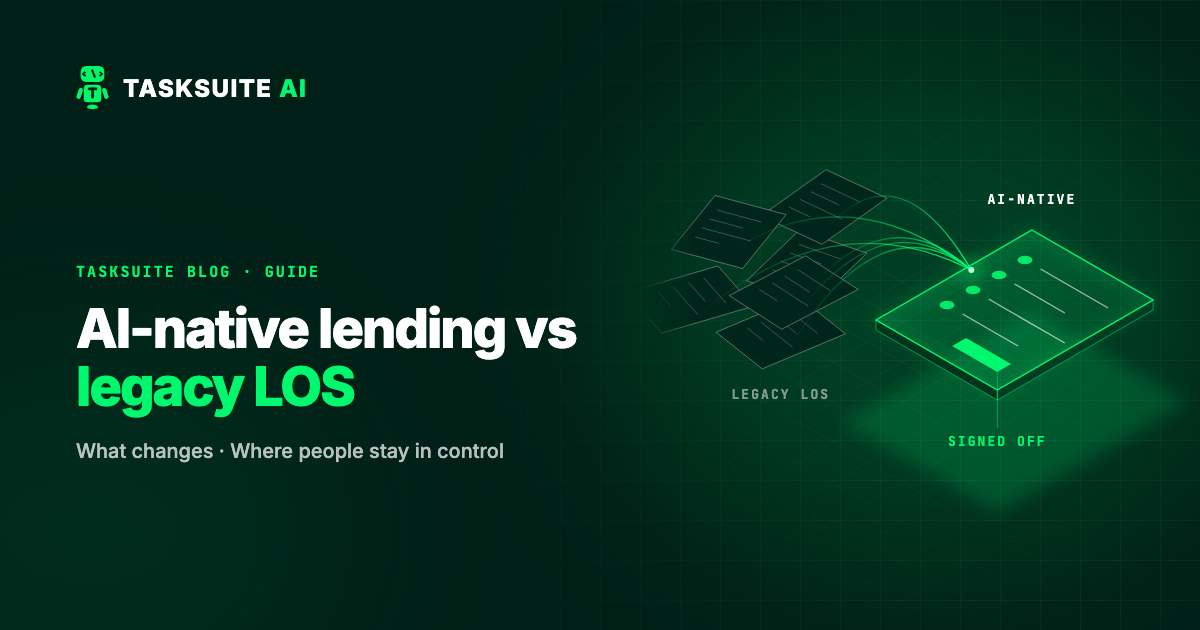
A legacy loan origination system (LOS) was built to route and record loan work while people do it. An "AI-enabled" LOS adds AI features, such as document OCR or a fraud score, to that same design. An AI-native lending platform is built the other way round: AI agents prepare the work, from collecting documents to drafting the credit memo, and hand a person a decision-ready file to review and sign off.
This guide is for community and regional banks, credit unions, fintech lenders, and specialty and alternative lenders comparing "AI-native" claims with the system they run today. It defines the terms vendors use, shows where the real differences are, and helps you tell whether you need a new system or a new layer.
What do AI-native, AI-enabled and agentic mean?
These words get used loosely. Here is how we use them, and how most buyer guides draw the line in 2026.
- Legacy LOS: a system of record built around forms, queues, checklists and rules. It stores the application, documents, decisions and audit history, and moves the file from stage to stage. People do the analysis. Many are still excellent systems of record.
- AI-enabled LOS: in Ocrolus's words, "traditional systems that have incorporated AI capabilities over time": document classification, OCR, a fraud score, a chatbot. The features help, but the workflow is unchanged, and staff still assemble the file.
- AI-native platform: built from the start with AI as the main way the work gets done. It reads the file, spreads the financials, applies the lender's policy, drafts the memo and flags exceptions, then gives a person a reviewable result.
- Agentic: software agents that act across steps and systems, not just answer questions. A document collection agent notices a missing bank statement, asks the borrower for it, checks the upload and updates the loan record.
- System of record vs system of execution: Uptiq's shorthand. "An LOS is a system of record. AI Agents are a system of execution." You need both.
How is an AI-native platform different from a legacy LOS?
| Legacy LOS | AI-enabled LOS | AI-native platform or agent layer | |
|---|---|---|---|
| Built around | Forms, stages, checklists | The same, with AI modules attached | AI agents preparing the work, people approving it |
| What lands on the desk | A queue of files and raw documents | Raw data with some fields filled | A decision-ready file: documents checked, financials spread, memo drafted |
| Document collection | Portal plus manual follow-up | OCR and classification on upload | Agent requests missing items, validates them and updates the record |
| Underwriting | Analyst spreads and writes | Extraction and scoring help | Agent drafts the memo; the underwriter reviews and decides |
| Explainability | Audit log of who did what | Varies by feature | Each recommendation shows the policy rule and data behind it |
| Where people spend time | Doing the work | Doing most of the work | Reviewing, deciding and handling exceptions |
| How you adopt it | Already in place | Add-on licences | Replace the LOS, or add a layer on top of the one you keep |
What actually changes for the underwriter?
The clearest test is what lands on an underwriter's desk. With a legacy or AI-enabled LOS, an analyst still pulls tax returns, spreads several years of financials and writes the credit memo. With an AI-native approach, the file arrives assembled: documents read and validated, bureau data pulled, ratios calculated against the lender's policy, and a memo drafted with a recommendation and the reasons behind it. The underwriter's time goes to judgment calls and exceptions rather than data entry.
That is the work TaskSuite's Loan Credit Agents do. TaskSuite's published figure for lenders using them is 80% faster underwriting.
Where do AI agents save the most time?
Document collection is where most lending teams lose days, and it's the easiest place to see the difference. A legacy LOS gives the borrower a portal; staff watch for uploads, check them and email for what's missing. An agent checks completeness against the product's requirements, asks for the missing or expired item, reads the new upload and writes the result back to the LOS.
It's also low-risk: nothing about the credit decision changes, and the time saved is easy to measure. That's why most lenders, and most TaskSuite deployments, start there before moving on to credit memo preparation.
Is AI-native lending safe for banks and credit unions?
It can be, if the platform keeps people in charge of credit decisions. AI-native shouldn't mean unsupervised. Look for:
- Sign-off on every credit decision. Agents prepare and recommend; a person approves, declines or counters. Routine steps such as a document request can run within rules the lender sets.
- Explanations. Each recommendation shows the policy rule and the data behind it, which matters for adverse action notices under ECOA and Regulation B.
- A full audit trail. Every action is logged with who or what took it.
- Sandbox testing before anything touches live loans.
Ask any vendor to show you these controls working, not just describe them.
Do you have to replace your LOS to go AI-native?
Usually not. AI-native work doesn't have to live inside the LOS. If your LOS holds a clean loan record and has APIs, an agent layer can read from it, do the work and write the results back, starting with one workflow. Replacement makes sense when the vendor is ending support, the system can't handle a product you need, or you're launching a new lending program from scratch.
We cover how that connection works, what to automate first and what examiners expect in how to add AI to your lending without replacing your LOS or core.
Which vendors take which approach?
These are examples, not a ranking. Confirm current features with each vendor.
- Established platforms adding AI: ICE Mortgage Technology's Encompass (mortgage), MeridianLink (consumer and mortgage lending for community institutions), nCino (bank operating platform on Salesforce) and Abrigo, which launched its agentic platform, APX, in July 2026, with general availability for lending expected in the third quarter. These are strong systems of record that many banks and credit unions should keep.
- AI-native origination systems: Vesta (mortgage) and Aloan (commercial lending for community banks and credit unions, which can also run alongside an existing LOS).
- AI layers that work with your LOS: Uptiq (AI agents and document AI for banks, credit unions and non-bank lenders), Ocrolus (document automation) and SecureLend (an AI underwriting service, which describes itself as "not an LOS").
- Both paths in one vendor: TaskSuite.
Where does TaskSuite fit?
TaskSuite offers both paths:
- AI agents on the systems you already run. The Loan Origination Agents (lead outreach, lead qualification, application assistance, document collection, contracts and e-signature, pipeline analytics) and the Loan Credit Agents (credit memo, document intelligence, bureau data, fraud detection, decision and risk analytics) connect to your existing LOS, LMS, CRM and core. No migration. Loan Servicing Agents for payments, escrow and collections are coming soon.
- The full Loan Suite. For lenders who want one platform or are launching a new program, TaskSuite's origination, credit, servicing and loan management modules run on a single loan record, with the same agents built in.
TaskSuite serves 200+ lenders: small business and MCA funders, fintech and specialty lenders, and credit unions and banks. Either way, agents prepare the work and your team signs off, with an audit trail on every step.
FAQ
What is an AI-native lending platform?
A lending platform where AI agents do the core preparation work (document collection, verification, financial spreading, credit memo drafting) and give a person a decision-ready, explained result. AI is the main operating layer, not an added feature.
What's the difference between AI-native and AI-enabled?
AI-enabled means a traditional system with AI features added, while people still do most of the analysis. AI-native means the platform is designed so AI prepares the work and people review and decide.
Which lenders benefit most?
Lenders with high document volume and manual underwriting prep: community banks and credit unions running commercial, SBA and consumer programs, fintech lenders growing volume, and specialty lenders with complex files.
Where should a lender start?
With the one workflow that takes the most staff time, usually document collection or credit memo preparation. Measure the time saved, then expand.
Sources
- Uptiq, AI agents vs traditional LOS (system of record vs system of execution)
- Ocrolus, AI-native vs AI-enabled lending (AI-enabled definition)
- AWS, Abrigo launches agentic AI platform (July 2026)
- HousingWire, Vesta raises $30 million Series B (October 2026)
- Aloan and SecureLend, the vendors' own descriptions